

How Many Flight Service Stations Are There
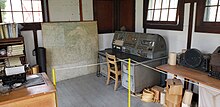
A flying service station (FSS)[1] is an air traffic facility that provides data and services to aircraft pilots earlier, during, and after flights, just dissimilar air traffic command (ATC), is not responsible for giving instructions or clearances or providing separation. They do, yet, relay clearances from ATC for departure or approaches. The people who communicate with pilots from an FSS are referred to equally flight service specialists.
The precise services offered by stations vary past country, just typical FSS services may include providing preflight briefings including weather condition and notices to airmen (NOTAMs); filing, opening, and closing flying plans; monitoring navigational aids (NAVAIDs); collecting and disseminating airplane pilot reports (PIREPs) and aerodrome surface weather observations; offering traffic advisories to aircraft on the ground or in flight; relaying instructions or clearances from air traffic command; relaying information from or well-nigh airborne aircraft to their abode bases, military bases or homeland security, providing weather advisories to aircraft inflight, initiating search and rescue on missing VFR aircraft, and providing assist in an emergency. In many countries, flight service stations also operate at mandatory frequency airports to help co-ordinate traffic in the absence of air traffic controllers, and may take over a control belfry frequency at a controlled airdrome when the tower is airtight.[2]
In well-nigh cases, it is possible to accomplish flying service stations either by radio in flight, or by telephone on the basis. Recently, some countries, such as Canada and the Us, have been consolidating flight services into large regional centres, replacing former local flying service stations with remote communications outlets (RCOs)[three] connected to the centres.
Flight services in unlike countries [edit]
Flying services in the U.s. [edit]
As of 2005, the FAA federal contractor for their flying service function throughout the continental U.Due south., Hawaii and the Caribbean was Lockheed Martin (LMFS).[4] Leidos has taken over as of 17 August 2016, following a merger with Lockheed Martin Data Systems & Global Solutions Business.[v] (AFSS used to refer to the Automated Flight Service Station. ) The FAA nevertheless oversees flight service in Alaska. At this time Leidos operates two big hub facilities. Flight service duties and responsibilities are divided into preflight, inflight and flight information.[6] They also monitor the HIWAS and TIBS recorded weather briefings, which pilots tin access via radio or telephone. The services are provided at no charge to the flying public. Preflight – Primarily responsible for filing flight plans, giving preflight weather condition briefings, and providing information apropos air traffic, they also take information from pilots coming into the US to notify the United states Customs Service that an shipping is inbound. The Leidos call tree has the ability to route calls to whatsoever flying service facility in the country.[7]
Inflight – which the pilots call "Radio", activates, cancels, and alters VFR flight plans. They have position reports and changes of destination for both civilian and military shipping. They relay IFR and SVFR clearances to aircraft on the ground either by phone or through their frequencies when there is no direct method of communication with the air traffic control facility governing the expanse. At border stations, Radio also takes information from aircraft crossing into the U.S., and issues squawk codes to VFR aircraft which place them to Homeland Security's radar. They relay data on forest fires to the U.Due south. Forest Service. Inflight monitors VHF and UHF frequencies, VOR voices, and emergency frequencies – from 60 to 100 different frequencies per area. The United states of america FSS radio frequencies are published in several FAA publications, including airdrome facility directories (AFD), VFR sectional maps, and IFR low and loftier altitude en route charts. When pilots take an inflight emergency, such as being lost, having smoke in the cockpit, or having low fuel and needing directions to the nearest drome with fuel, they call flight service for assistance.
Radio tin take flight plans and give pre-flight briefings over the radio in extenuating circumstances.[8]
Leidos until early 2016 had another inflight position chosen Flying Lookout, which was dedicated to updating weather condition for aircraft en route. Radio at present performs that function. Enroute Flight Advisory Service (EFAS) or Flight Lookout man was designed to requite pilots who are already airborne updates on weather during their electric current flight, and take pilots' reports or PIREPS, which they enter into the computer for transmission to the National Weather Service.[ix]
The Flight Information position in flight service is an informational clearinghouse that pilots seldom speak to unless they are calling for an IFR clearance by telephone. Flight Data is responsible for coordination with other air traffic facilities, U.S Customs and Homeland security, the Fire Service, military baseops, airport managers and law enforcement.
Search and rescue activities are initiated at Flight Data when VFR aircraft become overdue. Weather observers and airport tower operators call them to input weather observations or pilot reports to the National Atmospheric condition Service. LMFS added an selection for pilots in 2013 called Surveillance Enhanced Search and Rescue, SE-SAR,[10] which allows them to go on rails of en route shipping via satellite. Flight Data issues some types of Notices to Airmen (NOTAMs) through the FAA's East-Notam II figurer arrangement.[11]
Flying services in Canada [edit]
In Canada, Flight Information Centres (FIC) monitor the FISE frequencies (frequency 126.7 MHz is for broadcasts) too equally 121.5 MHz, the emergency frequency. However, Canadian FIC have phased out the use of 126.7 MHz for FISE (en route flight data) and are instead utilizing discrete frequencies. This is to subtract the frequency congestion often experienced on 126.7. These frequencies are found in the Canada Flight Supplement (CFS).
Different in the United states, even for VFR flights, pilots are required to file a flight plan or have a flying itinerary with a responsible person for any flight greater than 25 nm from the departure aerodrome.[12] Likewise, in Canada, flying plans are opened automatically at the estimated time of departure (ETD). Flight information centres play a prominent role managing flight plans, collecting position reports from pilots en route, and initiating commsearch procedures to locate pilots who have not closed flight plans.
There is no per-use charge for flight services, but shipping owners are required to pay Nav Canada a daily or annual fee, depending on aircraft weight, to support all air traffic services, both FSS and air traffic control (for a calorie-free private aircraft, the fee is approximately CAD 70/year). Strange low-cal shipping entering Canada are billed a quarterly fee.[13]
Canada has many mandatory frequency airports, which have enough traffic to justify special rules, but non plenty to justify a control tower. Many of these airports have an onsite FSS that pilots are required to contact, while others have Remote Aerodrome Advisory Services (RAAS) provided by an FSS in a different location. Rarely, an airport will have Mandatory Frequency Area rules, but no footing station.
Until 1996, the Canadian federal government operated all air traffic services (FSS and air traffic control) through Ship Canada, a regime department. Currently, a individual not-profit corporation, Nav Canada, operates both FSS/FIC and air traffic control and has significantly modernized the system, which involved the closing of some local FSSs. However, the company in plough created half-dozen large Flight Data Centres (FICs) situated at airports in Halifax, Quebec Urban center, London, Winnipeg, Edmonton and Kamloops. These provide standard en route flight services (weather briefing, flight-planning and commsearch). FSSs provide airport advisories, vehicle control, weather observations, clearance delivery, emergency assistance, and some provide Remote Drome Advisory Services. FSSs are responsible for the safety and efficient movement of aircraft on manoeuvering areas and within their designated control zone. Most FSS stations are open up 24/7; some have limited hours. They are no longer responsible for flight planning, except for sending departure and arrival messages to the appropriate FIC. The FICs have causeless the responsibleness for flight plans, filing, in-flight alerting, flight plan closures, interpretive weather briefings and NOTAM (NOtices To AirMen) management. The FICs likewise have large areas they are overseeing and have networks of RCOs, some of which are co-located with FSS or air traffic command sites. The FICs are similar in function and telescopic to the FAA's former automated FSS system in the Usa. Due north Bay FIC is tied into the N American Aerospace Defense Command (NORAD) Northward Alarm System (NWS) radar arrangement, and has a network of 23 RCOs located across Canada's Arctic coast. Quebec Urban center, North-Bay and Kamloops FIC too assist and oversee the "Community Airport Radio Station" (CARS) program.
References [edit]
- ^ "Aeronautical Information Transmission (AIM) - Page 632". faraim.org . Retrieved 2 September 2015.
- ^ FAA lodge 7110.10[ clarification needed ]
- ^ "Aeronautical Information Manual (AIM) - Page 682". faraim.org . Retrieved two September 2015.
- ^ "Flying Service by Lockheed Martin". afss.com . Retrieved 2 September 2015.
- ^ "Leidos Investor Relations - News Release". leidos.com . Retrieved 19 August 2016.
- ^ US Department of Transportation (7 March 2013), Air Traffic System Policy - Flight Services Archived 2009-08-15 at the Wayback Auto, retrieved 21 March 2014
- ^ "Preflight Services". AFSS. Retrieved 2014-03-22 .
- ^ "Inflight Services". AFSS. Retrieved 2014-03-22 .
- ^ Federal Aviation Administration (3 April 2014), Aeronautical Information Transmission section vii-i-5, retrieved 21 March 2014
- ^ "Surveillance-Enhanced SAR". AFSS. Retrieved 2014-03-22 .
- ^ The states Department of Transportation (3 April 2014), Gild JO 7930.2P Notices to Airmen (NOTAM), retrieved 21 March 2014
- ^ Canadian AIM RAC 3.6.1 Archived 2012-04-19 at the Wayback Machine
External links [edit]
- Leidos Flight Service

How Many Flight Service Stations Are There,
Source: https://en.wikipedia.org/wiki/Flight_service_station
Posted by: bowlingdersir.blogspot.com
0 Response to "How Many Flight Service Stations Are There"
Post a Comment